Following numerous customer requests we are delighted to announce that the first batch of liquid yeasts are now available on site and in store.
They are from Wyeast whose website gives plenty of instructions on how to make a yeast starter. We've selected the propogator packs so you can easily make 6 starters making this yeast much more economical to use that their dry counterparts.
Stand by for further developments on the all grain brewing front shortly and please keep telling us what you want.
Sunday, 1 May 2011
Sunday, 27 March 2011
The Easy Home Brew Guide To Bottling
Often referred to as the "home brewers biggest pain in the bottom" bottling takes time but, if done in an organised manner it can be mildly tolerable.
Priming
For me the most laborious aspect of bottling was putting priming sugar in each bottle so one of my early purchases were a little bottler and bottling bucket. Using this method of bottling eliminates this particular hassle and also ensures you get less sediment in the bottle.
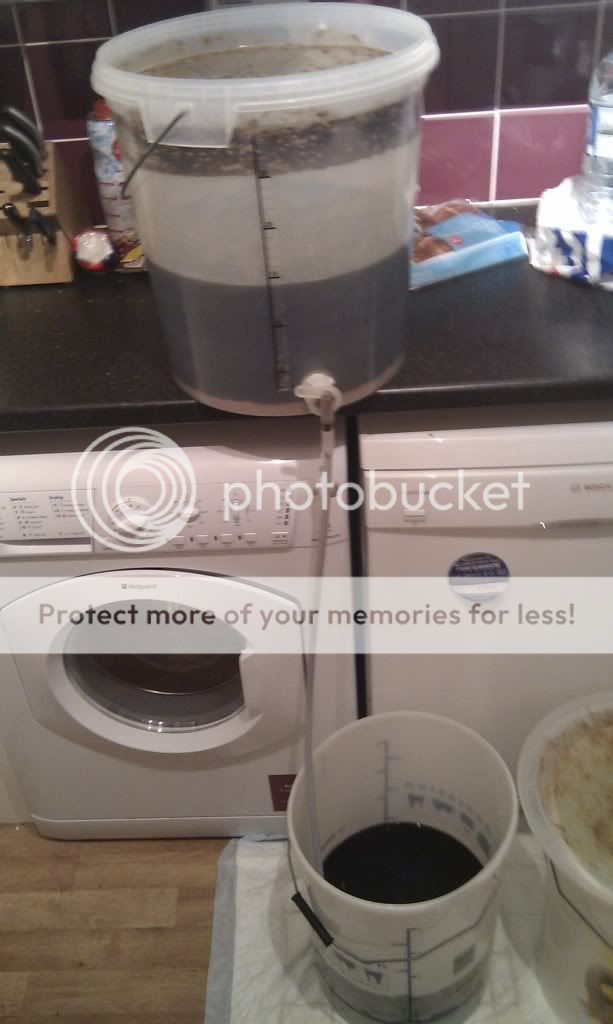
A bottling bucket is simply a fermenter with a 25mm hole at the bottom of the wall to accept the little bottler. The idea is that you simply rack the fermented beer in to the bottling bucket using a syphon. Leave the beer in there for 24-48 hours for it to settle out. Then you need to draw off about 200-300 ml of beer into a sterilised jug and warm it in the microwave (you can also warm it on a hob if you have no microwave). You then add the requisite amount of priming sugar (i.e.85g per 23L) and return in to the bottling bucket gently so as not to introduce too much oxygen.
After that it is simply a case of adding the bottling wand and bottling away; the valve at the bottom of the bottling wand opens when it touches the bottom of the bottle and allows the beer to flow through, when the beer reaches the top of the bottle, withdraw the wand and, hey presto, you've got the requisite amount of head space.
Cleaning and Draining
The other godsend I couldn't bottle beer without is the bottle rinser and drainer combination. Since I sterilise my bottles (and the drainer) in the bath, I then need somewhere to drain them whilst one of my teenagers requires the bathroom. I've taken to adding three chlorine bleach tablets per bath of water, leaving the bottles, rinser and drainer in there for half an hour.
When I'm sure the bottles are sterile, I take the drainer and rinser out, assemble it and then take the bottles out of the bath and leave them to drain. I then fill the rinser with boiled and cooled water and the bottling production line is almost complete.
Capping
Unless you use PET or swing top bottles, the final part of the bottling production line is capping. We sell three types at Easy Home Brew; the single handled hammer on capper, the twin lever capper and the bench capper. If you bottle a lot, I would look no further than the latter, because you can cap any bottle designed to take a crown cap which cannot be said for the twin handled lever capper. When using the bench capper, it will greatly assist your production line if they are all the same height as this will prevent you from having to adjust. Whichever method of capping you choose, please remember to sterilise your crown caps.
Production Line
I tend to use two crates which holds 20 bottles each. I fill these with beer then turn the tap on the little bottler off (you may need to place a jug underneath to catch the drips), I then move the first crate to another part of the kitchen, and cap them before starting on the second crate. This means the beer is not exposed to air longer than absolutely necessary.
Once the bottling is done, I label, pack into wine crates, which I also label and leave in the warm for a week (circa 20c) before transferring to the shed (c13c) for a period of conditioning.
Priming
For me the most laborious aspect of bottling was putting priming sugar in each bottle so one of my early purchases were a little bottler and bottling bucket. Using this method of bottling eliminates this particular hassle and also ensures you get less sediment in the bottle.
| Racking from fermenter to bottling bucket |
A bottling bucket is simply a fermenter with a 25mm hole at the bottom of the wall to accept the little bottler. The idea is that you simply rack the fermented beer in to the bottling bucket using a syphon. Leave the beer in there for 24-48 hours for it to settle out. Then you need to draw off about 200-300 ml of beer into a sterilised jug and warm it in the microwave (you can also warm it on a hob if you have no microwave). You then add the requisite amount of priming sugar (i.e.85g per 23L) and return in to the bottling bucket gently so as not to introduce too much oxygen.
After that it is simply a case of adding the bottling wand and bottling away; the valve at the bottom of the bottling wand opens when it touches the bottom of the bottle and allows the beer to flow through, when the beer reaches the top of the bottle, withdraw the wand and, hey presto, you've got the requisite amount of head space.
Cleaning and Draining
The other godsend I couldn't bottle beer without is the bottle rinser and drainer combination. Since I sterilise my bottles (and the drainer) in the bath, I then need somewhere to drain them whilst one of my teenagers requires the bathroom. I've taken to adding three chlorine bleach tablets per bath of water, leaving the bottles, rinser and drainer in there for half an hour.
When I'm sure the bottles are sterile, I take the drainer and rinser out, assemble it and then take the bottles out of the bath and leave them to drain. I then fill the rinser with boiled and cooled water and the bottling production line is almost complete.
Capping
Unless you use PET or swing top bottles, the final part of the bottling production line is capping. We sell three types at Easy Home Brew; the single handled hammer on capper, the twin lever capper and the bench capper. If you bottle a lot, I would look no further than the latter, because you can cap any bottle designed to take a crown cap which cannot be said for the twin handled lever capper. When using the bench capper, it will greatly assist your production line if they are all the same height as this will prevent you from having to adjust. Whichever method of capping you choose, please remember to sterilise your crown caps.
Production Line
I tend to use two crates which holds 20 bottles each. I fill these with beer then turn the tap on the little bottler off (you may need to place a jug underneath to catch the drips), I then move the first crate to another part of the kitchen, and cap them before starting on the second crate. This means the beer is not exposed to air longer than absolutely necessary.
Once the bottling is done, I label, pack into wine crates, which I also label and leave in the warm for a week (circa 20c) before transferring to the shed (c13c) for a period of conditioning.
Saturday, 19 March 2011
New Opening Hours at Easy Home Brew
In response to customer feedback we have decided to modify our opening hours. We realise that many (most) of our customers make wine or beer at weekends and that there is nothing worse than not being able to do so because the shop has shut by the time you finish work.
Because we are less than five minutes drive from Junction 10 of the M20 it is fairly easy for customers in South and East Kent to access us and, for this reason, we will be opening until 6pm on Friday nights. If you get stuck in traffic call us on 01233 502269 and we'll do our best to hang on for you.
However to be able to do this without increasing staff costs we need to close on Mondays, by far our quietest day of the week. So from Friday 1st April our opening hours will be:
Sunday & Monday: Closed
Tuesday, Wednesday & Thursday 10am - 4pm
Friday 10am - 6pm
Saturday 10am - 4pm
Internet orders received after 4pm on Saturday will be processed and dispatched first thing Tuesday morning.
Sunday, 6 March 2011
All Grain Brewing Supplies
We are absolutely delighted to announce the arrival of our all grain brewing supplies available to buy online or in the shop.
Grains
Maris Otter, crushed, available in 25, 10, 5 and 1kg weights
Lager Malt, crushed, available in 25, 10 and 5kg
Wheat Malt, crushed, available in 25, 5, 1kg and 500g packs
Crystal, Chocolate, Roasted Barley & Torrefied Wheat, crushed, available in 5, 1kg and 500g packs
Specialist Grains
Caramalt, crushed, available in 500g packs,
Flaked Rice
Diastatic Amber Malt
Crystal Wheat Malt
Acid Malt
Brown Malt
Carahell
Hops
All vacuum packed in 100g bags.
EKG 5.2%AA
Fuggles 5.4%AA
Saaz 2.2%AA
US Cascade 5.9%AA
US Citra 13.8%AA
US Apollo 19.5%AA
NZ Pacific Gem 17%AA
Sorachi Ace (Japan) 14.9%AA
US Columbus 17.9%AA
Liquid Yeasts
These will not be kept in stock but will be ordered on request 5-7 days lead time.
As always, please advise us if there are items you would like us to get in for you and we'll do our best.
Tuesday, 1 March 2011
Always Happy To See This In Our Mailbox
In online retail there is, perhaps, nothing so satisfying as receiving feedback from happy customers. So it was really nice to see that Jim from Perth sent us this note at the weekend.
"I can`t believe how quickly i recieved my order from you. Got it this morning and i only ordered it yesterday afternoon!!! Kent to Perth in Scotland......Dynamite service. Regards, Jim."
Thanks for sharing your shopping experience with us, Jim.
"I can`t believe how quickly i recieved my order from you. Got it this morning and i only ordered it yesterday afternoon!!! Kent to Perth in Scotland......Dynamite service. Regards, Jim."
Thanks for sharing your shopping experience with us, Jim.
Monday, 28 February 2011
Sorachi Ace Available to Pre Order
Further to our news regarding the Green Bullet hops, we have sourced a limited supply of Sorachi Ace hops. Used in beers like Sapporo Lager and more recently, Brew Dog's IPA is Dead, these Japanese hops are much sought after. We are expecting delivery on Tuesday 1st March but have a small quantity available at £4.50 per 100g. These will be dispatched, same day (or day after depending on the time of order) on a first come first served basis.
Saturday, 26 February 2011
New Hop Varieties Now Available
Great news hop lovers. We've got our hands on a limited supply of Green Bullet Hops. These high alpha dual purpose hops are great in pale beers. Here's a recipe I put together last year that turned out rather well (if I do say so myself).
Green Bullet Pale Ale
Estimated OG 1.049
Estimated Colour 11.9 EBC
Bitterness 44 IBU
Estimated ABV 4.6-5%
Grain Bill
4.25kg Maris Otter Pale Malt
250g Pale Crystal Malt
250g Torrefied Wheat
Hops
Green Bullet 20g 13.9% AA @ 90 mins
Green Bullet 10g 13.9% AA @ 30 mins
Green Bullet 25g 13.9%AA @ 0 mins
Protofloc tablet @ 5 mins
Yeast US-05
Subscribe to:
Posts (Atom)